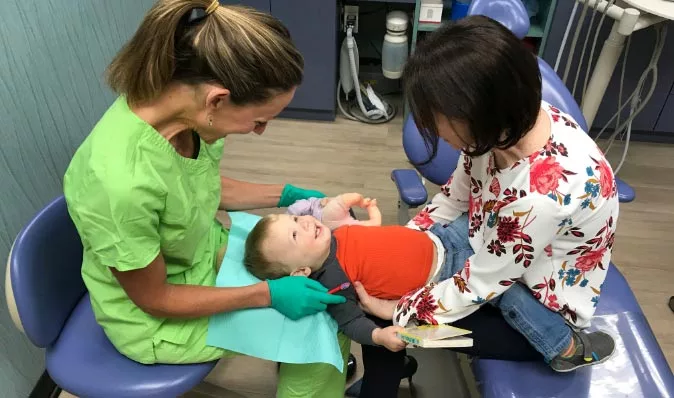
The pediatric dentist has an extra two to three years of
specialized training after dental school, and is dedicated to the
oral health of children from infancy through the teenage years. The
very young, pre-teens, and teenagers all need different approaches
in dealing with their behavior, guiding their dental growth and
development, and helping them avoid future dental problems. The
pediatric dentist is best qualified to meet these needs.
Why Are The
Primary Teeth Important?
It is very important to maintain the health of the primary teeth.
Neglected cavities can and frequently do lead to problems which
affect developing permanent teeth. Primary teeth, or baby teeth are
important for (1) proper chewing and eating, (2) providing space for
the permanent teeth and guiding them into the correct position, and
(3) permitting normal development of the jaw bones and muscles.
Primary teeth also affect the development of speech and add to an
attractive appearance. While the front 4 teeth last until 6-7 years
of age, the back teeth (cuspids and molars) aren’t replaced until
age 10-13.
Eruption Of Your Child's
Teeth
Children’s teeth begin forming before birth. As early as 4
months, the first primary (or baby) teeth to erupt through the gums
are the lower central incisors, followed closely by the upper
central incisors. Although all 20 primary teeth usually appear by
age 3, the pace and order of their eruption varies.
Permanent teeth begin appearing around age 6, starting with the
first molars and lower central incisors. This process continues
until approximately age 21.
Adults have 28 permanent teeth, or up to 32 including the third
molars (or wisdom teeth).
Look!
My Tooth is Loose!
(with 16"x22" poster and stickers)
By Patricia Brennan Dermuth
Illustrated by Mike Cressy
Dental Emergencies
Toothache:
Clean the area of the affected tooth. Rinse the mouth thoroughly
with warm water or use dental floss to dislodge any food that may be
impacted. If the pain still exists, contact your child's dentist. Do
not place aspirin or heat on the gum or on the aching tooth. If the
face is swollen, apply cold compresses and contact your dentist
immediately.
Cut or Bitten Tongue, Lip or Cheek: Apply ice to injured
areas to help control swelling. If there is bleeding, apply firm but
gentle pressure with a gauze or cloth. If bleeding cannot be
controlled by simple pressure, call a doctor or visit the hospital
emergency room.
Knocked Out Permanent Tooth: If possible, find the tooth.
Handle it by the crown, not by the root. You may rinse the tooth
with water only. DO NOT clean with soap, scrub or handle the tooth
unnecessarily. Inspect the tooth for fractures. If it is sound, try
to reinsert it in the socket. Have the patient hold the tooth in
place by biting on a gauze. If you cannot reinsert the tooth,
transport the tooth in a cup containing the patient’s saliva or
milk. If the patient is old enough, the tooth may also be carried in
the patient’s mouth (beside the cheek). The patient must see a
dentist IMMEDIATELY! Time is a critical factor in saving the tooth.
Knocked Out Baby Tooth: Contact your pediatric dentist
during business hours. This is not usually an emergency, and in most
cases, no treatment is necessary.
Chipped or Fractured Permanent Tooth: Contact your
pediatric dentist immediately. Quick action can save the tooth,
prevent infection and reduce the need for extensive dental
treatment. Rinse the mouth with water and apply cold compresses to
reduce swelling. If possible, locate and save any broken tooth
fragments and bring them with you to the dentist.
Chipped or Fractured Baby Tooth: Contact your pediatric
dentist.
Severe Blow to the Head: Take your child to the nearest
hospital emergency room immediately.
Possible Broken or Fractured Jaw: Keep the jaw from moving
and take your child to the nearest hospital emergency room.
Dental Radiographs (X-Rays)
Radiographs (X-Rays) are a vital and necessary part of your
child’s dental diagnostic process. Without them, certain dental
conditions can and will be missed.
Radiographs detect much more than cavities. For example,
radiographs may be needed to survey erupting teeth, diagnose bone
diseases, evaluate the results of an injury, or plan orthodontic
treatment. Radiographs allow dentists to diagnose and treat health
conditions that cannot be detected during a clinical examination. If
dental problems are found and treated early, dental care is more
comfortable for your child and more affordable for you.
The American Academy of Pediatric Dentistry recommends
radiographs and examinations every six months for children with a
high risk of tooth decay. On average, most pediatric dentists
request radiographs approximately once a year. Approximately every 3
years, it is a good idea to obtain a complete set of radiographs,
either a panoramic and bitewings or periapicals and bitewings.
Pediatric dentists are particularly careful to minimize the
exposure of their patients to radiation. With contemporary
safeguards, the amount of radiation received in a dental X-ray
examination is extremely small. The risk is negligible. In fact, the
dental radiographs represent a far smaller risk than an undetected
and untreated dental problem. Lead body aprons and shields will
protect your child. Today’s equipment filters out unnecessary x-rays
and restricts the x-ray beam to the area of interest. High-speed
film and proper shielding assure that your child receives a minimal
amount of radiation exposure.
What's The Best
Toothpaste For My Child?
Tooth
brushing is one of the most important tasks for good oral health.
Many toothpastes, and/or tooth polishes, however, can damage young
smiles. They contain harsh abrasives, which can wear away young
tooth enamel. When looking for a toothpaste for your child, make
sure to pick one that is recommended by the American Dental
Association as shown on the box and tube. These toothpastes have
undergone testing to insure they are safe to use.
Remember, children should spit out toothpaste after brushing to
avoid getting too much fluoride. If too much fluoride is ingested, a
condition known as fluorosis can occur. If your child is too young
or unable to spit out toothpaste, consider providing them with a
fluoride free toothpaste, using no toothpaste, or using only a "pea
size" amount of toothpaste.
Does Your Child Grind His
Teeth At Night? (Bruxism)
Parents are often concerned about the nocturnal grinding of teeth
(bruxism). Often, the first indication is the noise created by the
child grinding on their teeth during sleep. Or, the parent may
notice wear (teeth getting shorter) to the dentition. One theory as
to the cause involves a psychological component. Stress due to a new
environment, divorce, changes at school; etc. can influence a child
to grind their teeth. Another theory relates to pressure in the
inner ear at night. If there are pressure changes (like in an
airplane during take-off and landing, when people are chewing gum,
etc. to equalize pressure) the child will grind by moving his jaw to
relieve this pressure.
The majority of cases of pediatric bruxism do not require any
treatment. If excessive wear of the teeth (attrition) is present,
then a mouth guard (night guard) may be indicated. The negatives to
a mouth guard are the possibility of choking if the appliance
becomes dislodged during sleep and it may interfere with growth of
the jaws. The positive is obvious by preventing wear to the primary
dentition.
The good news is most children outgrow bruxism. The grinding
decreases between the ages 6-9 and children tend to stop grinding
between ages 9-12. If you suspect bruxism, discuss this with your
pediatrician or pediatric dentist.
Thumb Sucking
Sucking
is a natural reflex and infants and young children may use thumbs,
fingers, pacifiers and other objects on which to suck. It may make
them feel secure and happy, or provide a sense of security at
difficult periods. Since thumb sucking is relaxing, it may induce
sleep.
Thumb sucking that persists beyond the eruption of the permanent
teeth can cause problems with the proper growth of the mouth and
tooth alignment. How intensely a child sucks on fingers or thumbs
will determine whether or not dental problems may result. Children
who rest their thumbs passively in their mouths are less likely to
have difficulty than those who vigorously suck their thumbs.
Children should cease thumb sucking by the time their permanent
front teeth are ready to erupt. Usually, children stop between the
ages of two and four. Peer pressure causes many school-aged children
to stop.
Pacifiers are no substitute for thumb sucking. They can affect
the teeth essentially the same way as sucking fingers and thumbs.
However, use of the pacifier can be controlled and modified more
easily than the thumb or finger habit. If you have concerns about
thumb sucking or use of a pacifier, consult your pediatric dentist.
A few suggestions to help your child get through thumb sucking:
Children often suck their thumbs when feeling insecure.
Focus on correcting the cause of anxiety, instead of the thumb
sucking.
Children who are sucking for comfort will feel less of a
need when their parents provide comfort.
Reward children when they refrain from sucking during
difficult periods, such as when being separated from their
parents.
Your pediatric dentist can encourage children to stop
sucking and explain what could happen if they continue.
If these approaches don’t work, remind the children of their
habit by bandaging the thumb or putting a sock on the hand at
night. Your pediatric dentist may recommend the use of a mouth
appliance.
The pulp of a tooth is the inner, central core of the tooth. The
pulp contains nerves, blood vessels, connective tissue and
reparative cells. The purpose of pulp therapy in Pediatric Dentistry
is to maintain the vitality of the affected tooth (so the tooth is
not lost).
Dental caries (cavities) and traumatic injury are the main
reasons for a tooth to require pulp therapy. Pulp therapy is often
referred to as a "nerve treatment", "children's root canal", "pulpectomy"
or "pulpotomy". The two common forms of pulp therapy in children's
teeth are the pulpotomy and pulpectomy.
A pulpotomy removes the diseased pulp tissue within the crown
portion of the tooth. Next, an agent is placed to prevent bacterial
growth and to calm the remaining nerve tissue. This is followed by a
final restoration (usually a stainless steel crown).
A pulpectomy is required when the entire pulp is involved (into
the root canal(s) of the tooth). During this treatment, the diseased
pulp tissue is completely removed from both the crown and root. The
canals are cleansed, disinfected and, in the case of primary teeth,
filled with a resorbable material. Then, a final restoration is
placed. A permanent tooth would be filled with a non-resorbing
material.
What Is The Best Time
For Orthodontic Treatment?
Developing
malocclusions, or bad bites, can be recognized as early as 2-3 years
of age. Often, early steps can be taken to reduce the need for major
orthodontic treatment at a later age.
Stage I – Early Treatment: This period of treatment
encompasses ages 2 to 6 years. At this young age, we are concerned
with underdeveloped dental arches, the premature loss of primary
teeth, and harmful habits such as finger or thumb sucking. Treatment
initiated in this stage of development is often very successful and
many times, though not always, can eliminate the need for future
orthodontic/orthopedic treatment.
Stage II – Mixed Dentition: This period covers the ages of
6 to 12 years, with the eruption of the permanent incisor (front)
teeth and 6 year molars. Treatment concerns deal with jaw
malrelationships and dental realignment problems. This is an
excellent stage to start treatment, when indicated, as your child’s
hard and soft tissues are usually very responsive to orthodontic or
orthopedic forces.
Stage III – Adolescent Dentition: This stage deals with
the permanent teeth and the development of the final bite
relationship.
Early Infant Oral Care
Perinatal & Infant
Oral Health
The
American Academy of Pediatric Dentistry (AAPD) recommends that all
pregnant women receive oral healthcare and counseling during
pregnancy. Research has shown evidence that periodontal disease can
increase the risk of preterm birth and low birth weight. Talk to
your doctor or dentist about ways you can prevent periodontal
disease during pregnancy.
Additionally, mothers with poor oral health may be at a greater
risk of passing the bacteria which causes cavities to their young
children. Mother's should follow these simple steps to decrease the
risk of spreading cavity-causing bacteria:
Visit your dentist regularly.
Brush and floss on a daily basis to reduce bacterial plaque.
Proper diet, with the reduction of beverages and foods high
in sugar & starch.
Use a fluoridated toothpaste recommended by the ADA and
rinse every night with an alocohol-free, over-the-counter mouth
rinse with .05 % sodium fluoride in order to reduce plaque
levels.
Don't share utensils, cups or food which can cause the
transmission of cavity-causing bacteria to your children.
Use of xylitol chewing gum (4 pieces per day by the mother)
can decrease a child’s caries rate.
Your Child's First
Dental Visit-Establishing A "Dental Home"
The American Academy of Pediatrics (AAP), the American Dental
Association (ADA), and the American Academy of Pediatric Dentistry
(AAPD) all recommend establishing a "Dental Home" for your child by
one year of age. Children who have a dental home are more likely to
receive appropriate preventive and routine oral health care.
The
Dental Home is intended to provide a place other than the Emergency
Room for parents.
You can make the first visit to the dentist enjoyable and
positive. If old enough, your child should be informed of the visit
and told that the dentist and their staff will explain all
procedures and answer any questions. The less to-do concerning the
visit, the better.
It is best if you refrain from using words around your child that
might cause unnecessary fear, such as needle, pull, drill or hurt.
Pediatric dental offices make a practice of using words that convey
the same message, but are pleasant and non-frightening to the child.
When Will My Baby Start
Getting Teeth?
Teething, the process of baby (primary) teeth coming through the
gums into the mouth, is variable among individual babies. Some
babies get their teeth early and some get them late. In general, the
first baby teeth to appear are usually the lower front (anterior)
teeth and they usually begin erupting between the age of 6-8 months.
See "Eruption of Your Child’s
Teeth" for more details.
Baby Bottle Tooth Decay
(Early Childhood Caries)
One
serious form of decay among young children is baby bottle tooth
decay. This condition is caused by frequent and long exposures of an
infant’s teeth to liquids that contain sugar. Among these liquids
are milk (including breast milk), formula, fruit juice and other
sweetened drinks.
Putting a baby to bed for a nap or at night with a bottle other
than water can cause serious and rapid tooth decay. Sweet liquid
pools around the child’s teeth giving plaque bacteria an opportunity
to produce acids that attack tooth enamel. If you must give the baby
a bottle as a comforter at bedtime, it should contain only water. If
your child won't fall asleep without the bottle and its usual
beverage, gradually dilute the bottle's contents with water over a
period of two to three weeks.
After each feeding, wipe the baby’s gums and teeth with a damp
washcloth or gauze pad to remove plaque. The easiest way to do this
is to sit down, place the child’s head in your lap or lay the child
on a dressing table or the floor. Whatever position you use, be sure
you can see into the child’s mouth easily.
Dental Home
Starting at Age 1
The American Academy of Pediatrics (AAP), the American Dental
Association (ADA), and the American Academy of Pediatric Dentistry
(AAPD) all recommend establishing a "Dental Home" for your child
by one year of age.
The Dental Home is intended to provide a place
other than the Emergency Room for parents.
Pleasant First Visit
When the child is seen at one year, the first visit can be pleasant
and uneventful, introducing the child and parents to the dental office.
Emphasis is on the developmental assessment of the child’s oral health.
Caries (tooth decay) or developmental disturbances can be managed early.
Fluoride varnish may be applied to counteract beginning decay on newly
erupted teeth.
Five Steps for Baby's First Dental Visit
Step 1
Clinical Examination
by Age 12 Months
Complete medical history
Knee-to-knee exam with guardian
Note clinical dental caries
Soft tissue irregularities
White-spot lesions, tongue anatomy
Enamel decalification, hypoplasia
Dietary staining
Step 2
Caries Risk Assessment
Bottle or breast fed at night on demand
Non-water in bedtime bottle
Decalcification/caries present
No oral home care
Sugary foods, snacks
Step 3
Diet Counseling for Infants
No juice or milk in bed
Sippy cups can encourage decay
Avoid sugar drinks, sodas
Encourage variety and a balanced diet
Low-sugar snacks
Fluorides – topical and systemic
Step 4
Oral Home Care for Infants
Brush/massage teeth and gums 2x daily
Small, soft toothbrush
Tiny amount of toothpaste, with Fluoride
Guidance on thumb sucking, pacifier
Response for home accidents, trauma
Step 5
Future Visit
Based on Risk Assessment
At age one year
Two years if delayed in development
Prevention
Care Of Your Child's
Teeth
Good Diet = Healthy Teeth
Healthy
eating habits lead to healthy teeth. Like the rest of the body, the
teeth, bones and the soft tissues of the mouth need a well-balanced
diet. Children should eat a variety of foods from the five major
food groups. Most snacks that children eat can lead to cavity
formation. The more frequently a child snacks, the greater the
chance for tooth decay. How long food remains in the mouth also
plays a role. For example, hard candy and breath mints stay in the
mouth a long time, which cause longer acid attacks on tooth enamel.
If your child must snack, choose nutritious foods such as
vegetables, low-fat yogurt, and low-fat cheese, which are healthier
and better for children’s teeth.
How Do I Prevent
Cavities?
Good oral hygiene removes bacteria and the left over food
particles that combine to create cavities. For infants, use a wet
gauze or clean washcloth to wipe the plaque from teeth and gums.
Avoid putting your child to bed with a bottle filled with anything
other than water. See "Baby
Bottle Tooth Decay" for more information.
For older children, brush their teeth at least twice a
day. Also, watch the number of snacks containing sugar that you give
your children.
The American Academy of Pediatric Dentistry recommends visits
every six months to the pediatric dentist, beginning at your child’s
first birthday. Routine visits will start your child on a lifetime
of good dental health.
Your pediatric dentist may also recommend protective sealants or
home fluoride treatments for your child. Sealants can be applied to
your child’s molars to prevent decay on hard to clean surfaces.
Seal Out Decay
Before Sealant Applied
After Sealant Applied
A sealant is a clear or shaded plastic material that is applied
to the chewing surfaces (grooves) of the back teeth (premolars and
molars), where four out of five cavities in children are found. This
sealant acts as a barrier to food, plaque and acid, thus protecting
the decay-prone areas of the teeth.
Fluoride
Fluoride is an element, which has been shown to be beneficial to
teeth. However, too little or too much fluoride can be detrimental
to the teeth. Little or no fluoride will not strengthen the teeth to
help them resist cavities. Excessive fluoride ingestion by
preschool-aged children can lead to dental fluorosis, which is a
chalky white to even brown discoloration of the permanent teeth.
Many children often get more fluoride than their parents realize.
Being aware of a child’s potential sources of fluoride can help
parents prevent the possibility of dental fluorosis.
Some of these sources are:
Too much fluoridated toothpaste at an early age.
The inappropriate use of fluoride supplements.
Hidden sources of fluoride in the child’s diet.
Two and three year olds may not be able to expectorate (spit out)
fluoride-containing toothpaste when brushing. As a result, these
youngsters may ingest an excessive amount of fluoride during tooth
brushing. Toothpaste ingestion during this critical period of
permanent tooth development is the greatest risk factor in the
development of fluorosis.
Excessive and inappropriate intake of fluoride supplements may
also contribute to fluorosis. Fluoride drops and tablets, as well as
fluoride fortified vitamins should not be given to infants younger
than six months of age. After that time, fluoride supplements should
only be given to children after all of the sources of ingested
fluoride have been accounted for and upon the recommendation of your
pediatrician or pediatric dentist.
Certain foods contain high levels of fluoride, especially
powdered concentrate infant formula, soy-based infant formula,
infant dry cereals, creamed spinach, and infant chicken products.
Please read the label or contact the manufacturer. Some beverages
also contain high levels of fluoride, especially decaffeinated teas,
white grape juices, and juice drinks manufactured in fluoridated
cities.
Parents can take the following steps to decrease the risk of
fluorosis in their children’s teeth:
Use baby tooth cleanser on the toothbrush of the very young
child.
Place only a pea sized drop of children’s toothpaste on the
brush when brushing.
Account for all of the sources of ingested fluoride before
requesting fluoride supplements from your child’s physician or
pediatric dentist.
Avoid giving any fluoride-containing supplements to infants
until they are at least 6 months old.
Obtain fluoride level test results for your drinking water
before giving fluoride supplements to your child (check with
local water utilities).
Mouth Guards
When
a child begins to participate in recreational activities and
organized sports, injuries can occur. A properly fitted mouth guard,
or mouth protector, is an important piece of athletic gear that can
help protect your child’s smile, and should be used during any
activity that could result in a blow to the face or mouth.
Mouth guards help prevent broken teeth, and injuries to the lips,
tongue, face or jaw. A properly fitted mouth guard will stay in
place while your child is wearing it, making it easy for them to
talk and breathe.
Ask your pediatric dentist about custom and store-bought mouth
protectors.
Xylitol - Reducing Cavities
The American Academy of Pediatric Dentistry (AAPD) recognizes the
benefits of xylitol on the oral health of infants, children,
adolescents, and persons with special health care needs.
The use of XYLITOL GUM by mothers (2-3 times per day) starting 3
months after delivery and until the child was 2 years old, has
proven to reduce cavities up to 70% by the time the child was 5
years old.
Studies using xylitol as either a sugar substitute or a small
dietary addition have demonstrated a dramatic reduction in new tooth
decay, along with some reversal of existing dental caries. Xylitol
provides additional protection that enhances all existing prevention
methods. This xylitol effect is long-lasting and possibly permanent.
Low decay rates persist even years after the trials have been
completed.
Xylitol is widely distributed throughout nature in small amounts.
Some of the best sources are fruits, berries, mushrooms, lettuce,
hardwoods, and corn cobs. One cup of raspberries contains less than
one gram of xylitol.
Studies suggest xylitol intake that consistently produces
positive results ranged from 4-20 grams per day, divided into 3-7
consumption periods. Higher results did not result in greater
reduction and may lead to diminishing results. Similarly,
consumption frequency of less than 3 times per day showed no effect.
To find gum or other products containing xylitol, try visiting
your local health food store or search the Internet to find products
containing 100% xylitol.
Adolescent Dentistry
Tongue Piercing - Is It Really
Cool?
You might not be surprised anymore to see people with pierced
tongues, lips or cheeks, but you might be surprised to know just how
dangerous these piercings can be.
There are many risks involved with oral piercings, including
chipped or cracked teeth, blood clots, blood poisoning, heart
infections, brain abscess, nerve disorders (trigeminal neuralgia),
receding gums or scar tissue. Your mouth contains millions of
bacteria, and infection is a common complication of oral piercing.
Your tongue could swell large enough to close off your airway!
Common symptoms after piercing include pain, swelling, infection,
an increased flow of saliva and injuries to gum tissue.
Difficult-to-control bleeding or nerve damage can result if a blood
vessel or nerve bundle is in the path of the needle.
So follow the advice of the American Dental Association and give
your mouth a break – skip the mouth jewelry.
Tobacco - Bad News In Any Form
Tobacco in any form can jeopardize your child’s health and cause
incurable damage. Teach your child about the dangers of tobacco.
Smokeless tobacco, also called spit, chew or snuff, is often used
by teens who believe that it is a safe alternative to smoking
cigarettes. This is an unfortunate misconception. Studies show that
spit tobacco may be more addictive than smoking cigarettes and may
be more difficult to quit. Teens who use it may be interested to
know that one can of snuff per day delivers as much nicotine as 60
cigarettes. In as little as three to four months, smokeless tobacco
use can cause periodontal disease and produce pre-cancerous lesions
called leukoplakias.
If your child is a tobacco user you should watch for the
following that could be early signs of oral cancer:
A sore that won’t heal.
White or red leathery patches on the lips, and on or under
the tongue.
Pain, tenderness or numbness anywhere in the mouth or lips.
Difficulty chewing, swallowing, speaking or moving the jaw
or tongue; or a change in the way the teeth fit together.
Because the early signs of oral cancer usually are not painful,
people often ignore them. If it’s not caught in the early stages,
oral cancer can require extensive, sometimes disfiguring, surgery.
Even worse, it can kill.
Help your child avoid tobacco in any form. By doing so, they will
avoid bringing cancer-causing chemicals in direct contact with their
tongue, gums and cheek.
Sedation
Nitrous Oxide
Some children are given nitrous oxide/oxygen, or what you may know as
laughing gas, to relax them for their dental treatment. Nitrous
oxide/oxygen is a blend of two gases, oxygen and nitrous oxide. Nitrous
oxide/oxygen is given through a small breathing mask which is placed
over the child’s nose, allowing them to relax, but without putting them
to sleep. The American Academy of Pediatric Dentistry, recognizes this
technique as a very safe, effective technique to use for treating
children’s dental needs. The gas is mild, easily taken, then with normal
breathing, it is quickly eliminated from the body. It is non-addictive.
While inhaling nitrous oxide/oxygen, your child remains fully conscious
and keeps all natural reflexes.
Prior to your appointment:
Please inform us of any change to your child’s health and/or
medical condition.
Tell us about any respiratory condition that makes breathing
through the nose difficult for your child. It may limit the
effectiveness of the nitrous oxide/oxygen.
Let us know if your child is taking any medication on the day of
the appointment.
Conscious Sedation
Conscious Sedation is recommended for apprehensive children, very
young children, and children with special needs. It is used to calm your
child and to reduce the anxiety or discomfort associated with dental
treatments. Your child may be quite drowsy, and may even fall asleep,
but they will not become unconscious.
There are a variety of different medications, which can be used for
conscious sedation. The doctor will prescribe the medication best suited
for your child’s overall health and dental treatment recommendations. We
will be happy to answer any questions you might have concerning the
specific drugs we plan to give to your child.
Prior to your appointment:
Please notify us of any change in your child’s health and/or
medical condition. Do not bring your child for treatment with a
fever, ear infection or cold. Should your child become ill, contact
us to see if it is necessary to postpone the appointment.
You must tell the doctor of any drugs that your child is
currently taking and any drug reactions and/or change in medical
history.
Please dress your child in loose fitting, comfortable clothing.
Please make sure that your child goes to the bathroom
immediately prior to arriving at the office.
Your child should not have solid food for at least 6 hours
prior to their sedation appointment and only clear liquids for up to
4 hours before the appointment.
The child's parent or legal guardian must remain at the office
during the complete procedure.
Please watch your child closely while the medication is taking
effect. Hold them in your lap or keep close to you. Do not et them
"run around."
Your child will act drowsy and may become slightly excited at
first.
After the sedation appointment:
Your child will be drowsy and will need to be monitored very
closely. Keep your child away from areas of potential harm.
If your child wants to sleep, place them on their side with
their chin up. Wake your child every hour and encourage them to have
something to drink in order to prevent dehydration. At first it is
best to give your child sips of clear liquids to prevent nausea. The
first meal should be light and easily digestible.
If your child vomits, help them bend over and turn their head to
the side to insure that they do not inhale the vomit.
Because we use local anesthetic to numb your child’s mouth
during the procedure, your child may have the tendency to bite or
chew their lips, cheeks, and/or tongue and/or rub and scratch their
face after treatment. Please observe your child carefully to prevent
any injury to these areas.
Please call our office for any questions or concerns that you
might have.
Outpatient General Anesthesia
Outpatient General Anesthesia is recommended for apprehensive
children, very young children, and children with special needs that
would not work well under conscious sedation or I.V. sedation. General
anesthesia renders your child completely asleep. This would be the same
as if he/she was having their tonsils removed, ear tubes, or hernia
repaired. This is performed in a hospital or outpatient setting only.
While the assumed risks are greater than that of other treatment
options, if this is suggested for your child, the benefits of treatment
this way have been deemed to outweigh the risks. Most pediatric medical
literature places the risk of a serious reaction in the range of 1 in
25,000 to 1 in 200,000, far better than the assumed risk of even driving
a car daily. The inherent risks if this is not chosen are multiple
appointments, potential for physical restraint to complete treatment and
possible emotional and/or physical injury to your child in order to
complete their dental treatment. The risks of NO treatment include tooth
pain, infection, swelling, the spread of new decay, damage to their
developing adult teeth and possible life threatening hospitalization
from a dental infection.
Prior to your appointment:
Please notify us of any change in your child’s health. Do not
bring your child for treatment with a fever, ear infection or cold.
Should your child become ill, contact us to see if it is necessary
to postpone the appointment.
You must tell the doctor of any drugs that your child is
currently taking and any drug reactions and/or change in medical
history.
Please dress your child in loose fitting, comfortable clothing.
Your child should not have milk or solid food after midnight
prior to the scheduled procedure and clear liquids ONLY (water,
apple juice, Gatorade) for up to 6 hours prior to the appointment.
The child’s parent or legal guardian must remain at the hospital
or surgical site waiting room during the complete procedure.
After the appointment:
Your child will be drowsy and will need to be monitored very
closely. Keep your child away from areas of potential harm.
If your child wants to sleep, place them on their side with
their chin up. Wake your child every hour and encourage them to have
something to drink in order to prevent dehydration. At first it is
best to give your child sips of clear liquids to prevent nausea. The
first meal should be light and easily digestible.
If your child vomits, help them bend over and turn their head to
the side to insure that they do not inhale the vomit.
Prior to leaving the hospital/outpatient center, you will be
given a detailed list of "Post-Op Instructions" and an emergency
contact number if needed.
Post-Operative Care
Care of the Mouth After Local
Anesthetic
If the procedure was in the lower jaw the tongue, teeth, lip and
surrounding tissue will be numb or asleep.
If the procedure was in the upper jaw the teeth, lip and
surrounding tissue will be numb or asleep.
Often, children do not understand the effects of local
anesthesia, and may chew, scratch, suck, or play with the numb lip,
tongue, or cheek. These actions can cause minor irritations or they
can be severe enough to cause swelling and abrasions to the tissue.
Monitor your child closely for approximately two hours following
the appointment. It is often wise to keep your child on a liquid or
soft diet until the anesthetic has worn off.
Please do not hesitate to call the office if there are any questions.
Care of the Mouth After Trauma
Please keep the traumatized area as-clean-as possible. A soft
wash cloth often works well during healing to aid the process.
Watch for darkening of traumatized teeth. This could be an
indication of a dying nerve (pulp).
If the swelling should re-occur, our office needs to see the
patient as-soon-as possible. Ice should be administered during the
first 24 hours to keep the swelling to a minimum.
Watch for infection (gum boils) in the area of trauma. If
infection is noticed - call the office so the patient can be seen
as-soon-as possible.
Maintain a soft diet for two to three days, or until the child
feels comfortable eating normally again.
Avoid sweets or foods that are extremely hot or cold.
If antibiotics or pain medicines are prescribed, be sure to
follow the prescription as directed.
Please do not hesitate to call the office if there are any questions.
Care of the Mouth After Extractions
Do not scratch , chew, suck, or rub the lips, tongue, or cheek
while they feel numb or asleep. The child should be watched closely
so he/she does not injure his/her lip, tongue, or cheek before the
anesthesia wears off.
Do not rinse the mouth for several hours.
Do not spit excessively.
Do not drink a carbonated beverage (Coke, Sprite, etc.) for the
remainder of the day.
Do not drink through a straw.
Keep fingers and tongue away from the extraction area.
Bleeding - Some bleeding is to be expected. If unusual or
sustained bleeding occurs, place cotton gauze firmly over the extraction
area and bite down or hold in place for fifteen minutes. This can also
be accomplished with a tea bag. Repeat if necessary.
Maintain a soft diet for a day or two, or until the child feels
comfortable eating normally again.
Avoid strenuous exercise or physical activity for several hours
after the extraction.
Pain - For discomfort use Children's Tylenol, Advil, or Motrin
as directed for the age of the child. If a medicine was prescribed, then
follow the directions on the bottle.
Please do not hesitate to call the office if there are any questions.
Care of Sealants
By forming a thin covering over the pits and fissures, sealants keep
out plaque and food, thus decreasing the risk of decay. Since, the
covering is only over the biting surface of the tooth, areas on the side
and between teeth cannot be coated with the sealant. Good oral hygiene
and nutrition are still very important in preventing decay next to these
sealants or in areas unable to be covered.
Your child should refrain from eating ice or hard candy, which tend
to fracture the sealant. Regular dental appointments are recommended in
order for your child's dentist to be certain the sealants remain in
place.
The American Dental Association recognizes that sealants can play an
important role in the prevention of tooth decay. When properly applied
and maintained, they can successfully protect the chewing surfaces of
your child's teeth. A total prevention program includes regular visits
to the dentist, the use of fluoride, daily brushing and flossing, and
limiting the number of times sugar-rich foods are eaten. If these
measures are followed and sealants are used on the child's teeth, the
risk of decay can be reduced or may even be eliminated!